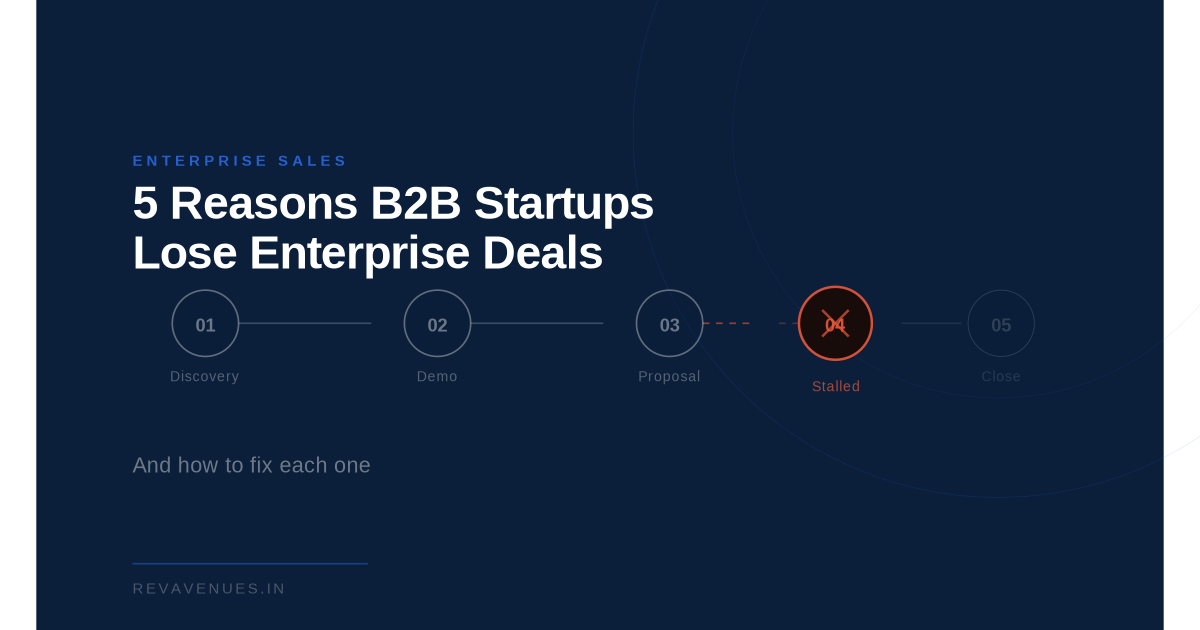
Most B2B startups lose enterprise deals not because their product is weak — but because of five fixable sales mistakes. Here's how to identify and correct each one.
Why do B2B startups struggle to close enterprise deals?
Enterprise buyers are sophisticated. They've seen hundreds of pitches, they manage complex internal politics, and they face real consequences for bad vendor decisions. Yet most B2B startups approach enterprise sales the same way they approach SMB sales — and wonder why they lose.
The good news: every reason enterprise deals fall apart is predictable and fixable.
Reason 1: Pitching to the wrong person
Most startups get a meeting with a mid-level manager who showed interest on LinkedIn, then spend weeks nurturing a champion who can't approve a budget over ₹5 lakh. Enterprise deals die when economic buyers — CFOs, VPs, C-suite — are never engaged.
The fix: In your first discovery call, ask: "Who else is typically involved in decisions like this?" Map the buying committee before you build a business case. If your champion can't get you in a room with the economic buyer, your deal is stalled before it starts.
Reason 2: Skipping proper discovery
Startups rush to demo. The moment a prospect shows interest, they open a screen share. The result: a generic demo that doesn't speak to the buyer's actual pain, and a prospect who walks away thinking "interesting, but not urgent."
The fix: Run a structured discovery call before any demo. Understand their current process, what's broken, what it's costing them. A demo built around their exact situation closes; a generic one doesn't.
Reason 3: No clear ROI story
Enterprise buyers need to justify spend internally. If you can't help them build that internal case — with numbers, timelines, and risk reduction — they can't get approval even if they want to buy.
The fix: Build a simple ROI calculator specific to their situation. "Based on what you told me, you're losing X hours per rep per week. At your team size and average OTE, that's ₹Y per year. Our solution typically recovers 70% of that in the first 90 days." Let them own the math.
Reason 4: Competing on features instead of outcomes
Feature comparisons are a race to the bottom. Enterprise buyers don't want the most features — they want the least risk and the clearest path to their outcome.
The fix: Reframe every conversation around business outcomes, not features. Instead of "we have an AI-powered dashboard," say "our clients in similar roles cut their reporting time by 60% in the first month." Outcomes close deals. Features get you to the shortlist.
Reason 5: Weak follow-through on next steps
Enterprise sales stall in the follow-up. A vague "I'll send over some info" after a great call is where most deals go to die. The enterprise buyer gets busy, the internal momentum fades, and your deal slips a quarter.
The fix: End every call with a bilateral commitment: a specific next step with a specific date, and something they agree to do in return. "I'll send the ROI model by Thursday. Can you share it with your CFO before our Friday call?" Specific. Mutual. Time-bound.
Frequently Asked Questions
Why do enterprise deals take so long to close?
Enterprise deals involve multiple stakeholders, formal procurement processes, and legal review. The average B2B enterprise sales cycle is 6–12 months. Startups shorten this by engaging economic buyers early, building internal champions, and removing friction from the approval process.
What's the biggest mistake B2B startups make in enterprise sales?
The single biggest mistake is treating enterprise sales like SMB sales — short cycles, single decision-maker, feature-led pitches. Enterprise sales requires multi-threaded relationships, an ROI-first narrative, and patience.
How do I get a meeting with the economic buyer?
Ask your champion directly: "For decisions of this size, who else typically needs to be involved?" Then ask them to facilitate the introduction. If they won't, that's a signal your deal is at risk.
What's the right length for an enterprise sales cycle?
It depends on deal size and company maturity. ₹10–50L ARR deals typically take 3–6 months. ₹1Cr+ deals can take 9–18 months. Trying to rush an enterprise cycle usually kills it.
How do RevAvenues clients improve enterprise close rates?
RevAvenues clients typically see 25–40% improvement in enterprise close rates within 6 months by implementing structured discovery, multi-stakeholder mapping, and ROI-first selling frameworks.
Ready to fix your enterprise pipeline?
RevAvenues helps B2B teams build repeatable enterprise revenue systems — from first touch to signed contract.
Talk to RevAvenues ↗