Your AI product just won the demo. The champion loves it, the business case is approved, and the VP says "let's do this." Then the deal disappears into a 140-question security questionnaire, a legal review of your data processing terms, and an AI governance committee nobody told you existed. Three months later, you're still "in procurement."
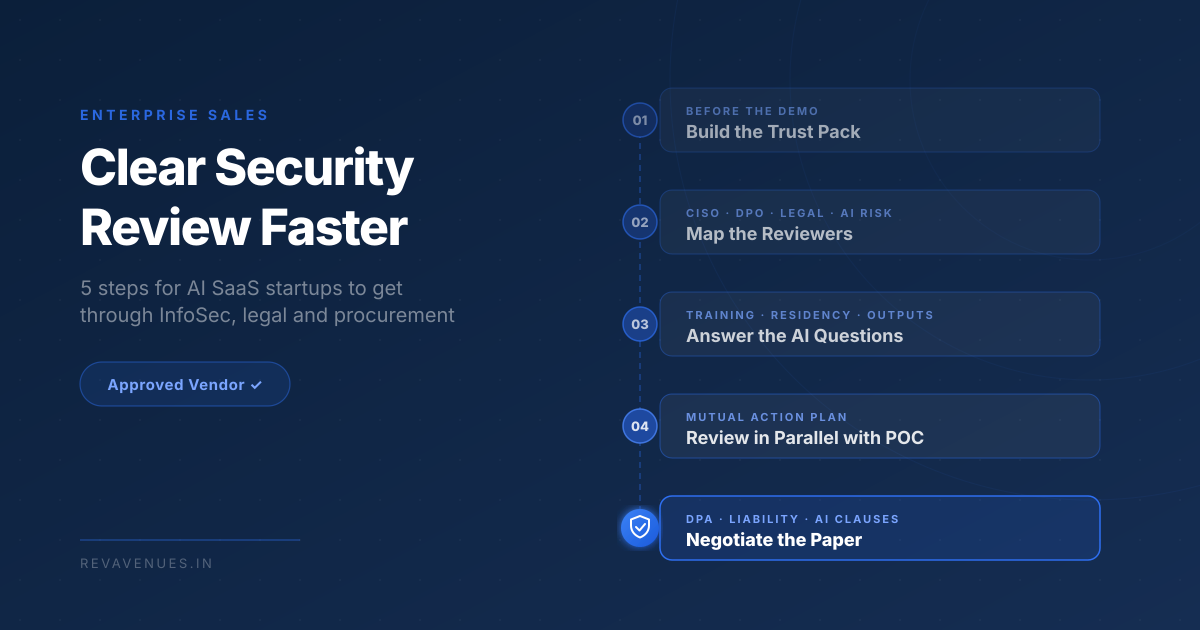
For AI and SaaS startups selling to enterprises in India and globally, security review and procurement are now where most late-stage deals stall. Not because the product is risky, but because the vendor shows up unprepared. Here's the RevAvenues Trust-Ready Framework: five steps that turn security review from a deal-killer into a formality.
Why do AI deals stall in enterprise security review?
Enterprise buyers have always vetted software vendors. What's changed is that AI products trigger a second, harder layer of scrutiny. A traditional SaaS tool stores data. An AI tool stores data, sends it to model providers, may learn from it, and produces outputs that someone in the business will act on. Every one of those steps is a new question for the CISO, the legal team, and increasingly, a dedicated AI risk or governance function.
In India, the pressure has intensified. The DPDP Rules, 2025 were notified in November 2025, putting the Digital Personal Data Protection Act, 2023 into phased effect through May 2027. Legal teams at Indian enterprises are already rewriting vendor contracts to match. BFSI buyers layer RBI's IT outsourcing directions or SEBI's cybersecurity framework on top. Global buyers bring GDPR, SOC 2 expectations and the EU AI Act.
The startups that close fastest treat security review as a sales stage with its own owner, plan and exit criteria. The ones that lose treat it as paperwork that happens after the "real" sale.
Three patterns show up again and again in stalled AI deals:
- The questionnaire arrives as a surprise. The founder sees it for the first time after verbal approval, and the team spends three weeks answering it from scratch.
- Nobody can answer the AI questions cleanly. "Do you train on our data?" gets a vague answer, and vague answers get escalated.
- Reviews run in sequence, not in parallel. Security finishes, then legal starts, then procurement starts. Each handoff adds two to four weeks.
Step 1: Build a Trust Pack before the first demo
The fastest way to shorten security review is to answer most of it before the buyer asks. A Trust Pack is a single, shareable folder (or a page on your trust portal) that gives a security reviewer 80% of what they need in the first hour.
What goes in a Trust Pack
- Security overview (2–3 pages): architecture diagram, hosting regions, encryption at rest and in transit, access controls, and how you handle incidents.
- Certifications or a credible roadmap: SOC 2 Type II and ISO 27001 are the most requested. If you don't have them yet, share your readiness status, auditor name and target date. A clear roadmap beats silence.
- A pre-filled standard questionnaire: complete a common framework such as the CAIQ or SIG Lite once, then reuse it. Most enterprise questionnaires overlap heavily with these.
- AI data-use statement: a one-page, plain-language answer to "what happens to our data inside your AI." More on this in Step 3.
- Sub-processor list: every third party that touches customer data, including your LLM providers, with their purpose and region.
- Draft DPA and standard security addendum: your own paper, ready to send, so legal reviews your terms instead of drafting theirs.
Key action: Share the Trust Pack with your champion right after discovery, not after the demo. Ask them to forward it to their security team early: "Your InfoSec team will need this eventually. Sending it now usually saves three to four weeks at the end."
Step 2: Map the reviewers, not just the buyers
Your buying committee map probably includes the champion, the economic buyer and maybe a technical evaluator. For AI deals, there's a second committee that can't say yes but can absolutely say no.
The five reviewers who can stall an AI deal
- CISO or InfoSec lead: owns the security questionnaire and the risk rating of your product.
- Data Protection Officer or privacy counsel: owns DPDP, GDPR and data-residency questions.
- Legal: owns the MSA, DPA, liability caps and AI-specific clauses.
- Procurement: owns vendor onboarding, commercial terms and the vendor master record.
- AI governance or model risk committee: a newer function at large enterprises, especially in BFSI and healthcare, that reviews AI use cases before they go live.
Each of these people has a different definition of "done." Security wants a risk rating. Legal wants signed paper. Procurement wants vendor registration. AI governance wants an approved use case. If you don't know who they are, you can't know when you're finished.
Key action: In your second or third call, ask your champion: "Walk me through what happened the last time your team bought a new AI or SaaS tool. Who reviewed it after the business said yes, and how long did each step take?" Their answer is your procurement timeline.
Step 3: Answer the AI-specific questions before they're asked
Standard security questions have standard answers. AI questions are where reviewers slow down, because they rarely get clear responses. A crisp, consistent answer here signals maturity and moves you up the queue.
The six questions every AI vendor must answer cleanly
- Do you train or fine-tune models on our data? Give a yes or no, then the detail. If the answer is no by default, say so in the first sentence and point to the contract clause.
- Which model providers do you use, and what do they retain? Name them. State their retention and training terms under your enterprise agreements.
- Where is our data processed and stored? Many Indian enterprises, especially in regulated sectors, will ask about in-country hosting. Know your regions and your options.
- How do you prevent data leaking between customers? Explain tenant isolation, including for embeddings, vector stores and prompt logs.
- How do you handle wrong or harmful outputs? Describe human-in-the-loop controls, confidence thresholds, logging and how customers can report issues.
- Can we audit what the AI did? Show what's logged, how long it's retained and how customers access it.
Key action: Write these six answers once, get your CTO and legal advisor to sign off, and use the same wording everywhere: website, Trust Pack, questionnaire and contract. Inconsistent answers across documents are the fastest way to trigger an escalation.
Step 4: Run security review in parallel with the POC
The single biggest time-saver in enterprise AI sales is running security, legal and procurement in parallel with the proof-of-concept, not after it. If the POC takes 30 days and review starts on day 31, you've just added a quarter to your cycle.
Use a mutual action plan with review milestones
A mutual action plan (MAP) is a shared, dated document listing every step to a signed contract, with an owner on each side. For AI deals, it should include review milestones alongside POC milestones:
- Week 1: POC kickoff with success criteria. Trust Pack sent to InfoSec. DPA sent to legal.
- Week 2: Security questionnaire returned. Vendor registration forms submitted to procurement.
- Week 3: Security follow-up call. Legal redlines received. AI governance review scheduled, if applicable.
- Week 4: POC results review. Security risk rating issued. Final redlines agreed.
- Week 5: Commercial decision call and signature.
Startups that run review in parallel typically close several weeks faster than those that run it in sequence, and they avoid the classic "the POC was great but we lost momentum" stall.
Key action: Make "security review kicked off" a formal exit criterion for starting the POC. If the buyer won't involve InfoSec during the pilot, ask why. It often means the project isn't truly sponsored yet.
Step 5: Negotiate the paper, not just the price
By the time an AI deal reaches legal, the commercial terms are usually agreed. What stalls it is the contract language around data, liability and AI. Founders often concede too much here out of fear of losing the deal, or dig in on clauses that don't matter.
The clauses that matter most in AI contracts
- Data use and training: a clear commitment that customer data is not used to train models without written consent. This is the clause buyers care about most, and the easiest to give if your architecture supports it.
- Liability caps: enterprises will push for uncapped or "super-capped" liability on data breaches. Agree a higher cap for data-protection breaches (often a multiple of annual fees) rather than going uncapped.
- Breach notification timelines: Indian buyers will reference CERT-In's six-hour incident reporting direction and DPDP breach obligations. Make sure your incident process can actually meet what you sign.
- Sub-processor changes: offer advance notice and a right to object, rather than prior approval for every change.
- AI output responsibility: make it clear that outputs support, not replace, human decisions in regulated workflows, and that the customer controls how outputs are used.
Key action: Build a pre-approved fallback position for each of these five clauses before you enter negotiation. When legal pushes back, you respond in 24 hours with an agreed alternative instead of waiting a week for internal discussion.
How enterprise AI procurement differs in India vs global markets
The framework holds everywhere, but the emphasis shifts by market.
Selling to Indian enterprises
- Expect questions about DPDP readiness, consent handling and breach notification, especially as the 2027 compliance deadline gets closer.
- BFSI buyers will map you against RBI's IT outsourcing directions or SEBI's cybersecurity framework. Have a one-page compliance mapping ready.
- Data localisation and in-country hosting come up early in regulated sectors. Have a clear answer on Indian cloud regions.
- Procurement often runs on formal vendor onboarding with GST, PAN and MSME documentation. Get this ready before the deal, not after.
Selling to US, UK and EU enterprises
- SOC 2 Type II is close to a hard requirement for mid-market and enterprise US buyers.
- EU buyers will ask how your product is classified under the EU AI Act and how you support GDPR data-subject requests.
- AI governance reviews increasingly reference frameworks such as ISO/IEC 42001 or the NIST AI Risk Management Framework. Know where you stand on both.
Your 30-day Trust-Ready checklist
If you're starting from zero, here's how to get enterprise-ready in a month without a dedicated security team:
- Days 1–7: Write your security overview, sub-processor list and the six AI answers. Get CTO sign-off.
- Days 8–14: Complete one standard questionnaire (CAIQ or SIG Lite) in full. Draft your DPA and security addendum with counsel.
- Days 15–21: Publish a simple trust page on your website. Start SOC 2 or ISO 27001 readiness if you haven't already, and document the target date.
- Days 22–30: Build your MAP template with review milestones. Agree fallback positions on the five key contract clauses. Train every seller to send the Trust Pack after discovery.
None of this requires a large team. It requires treating trust as part of your sales motion, owned and measured like every other stage in the pipeline.
Frequently Asked Questions
How long does enterprise security review take for an AI vendor?
It typically takes 4–12 weeks, depending on the buyer's industry and how prepared the vendor is. BFSI and healthcare buyers sit at the longer end because AI governance and regulatory mapping add extra review layers. Sharing a Trust Pack early and running review in parallel with the POC can remove several weeks from that timeline.
Do I need SOC 2 or ISO 27001 before selling to enterprises?
Not always, but you need a credible answer. Many enterprises will proceed with a vendor that is mid-audit if it can share a readiness assessment, auditor name and target date. US enterprise buyers increasingly treat SOC 2 Type II as a requirement, while Indian buyers more often ask for ISO 27001. Start readiness before your first large deal, not during it.
How does the DPDP Act affect AI SaaS vendors selling to Indian enterprises?
The DPDP Rules, 2025 put the Digital Personal Data Protection Act, 2023 into phased effect, with most obligations applying by May 2027. Indian enterprises are already updating vendor contracts to cover consent, purpose limitation, breach notification and processor obligations. AI vendors should expect DPDP-specific clauses in their DPA and questions about where personal data is processed and how long it is retained.
What should an AI data-use statement include?
A one-page, plain-language statement that answers six questions: whether you train on customer data, which model providers you use and what they retain, where data is processed and stored, how customer data is isolated, how wrong or harmful outputs are handled, and what is logged for audit. Use identical wording across your website, Trust Pack, questionnaire answers and contract.
Ready to fix your enterprise pipeline?
RevAvenues helps B2B teams build repeatable enterprise revenue systems — from first touch to signed contract.
Talk to RevAvenues ↗