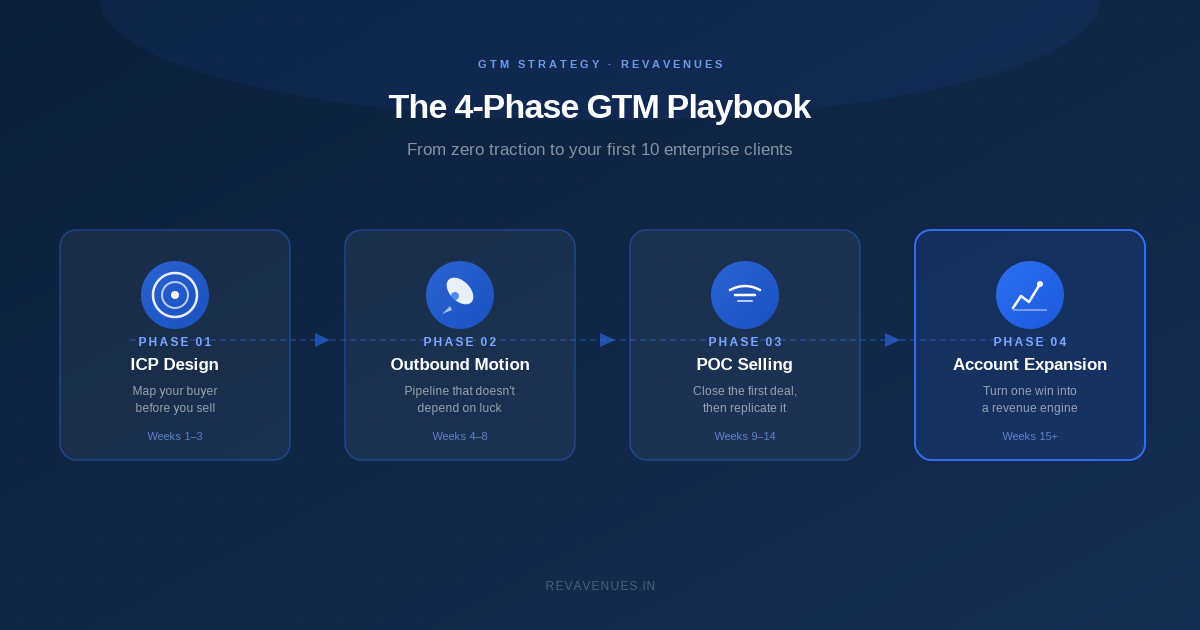
Most B2B startups spend their first year chasing deals that never close. They have a strong product, motivated founders, and real customer problems to solve — but no structured way to reach the right enterprise buyers, run a credible sales process, or convert pilots into contracts. The RevAvenues 4-Phase GTM Playbook is designed to change that. It gives B2B teams a repeatable motion from day one through scalable expansion.
Phase 1: ICP Design — Map Your Buyer Before You Sell
The most expensive GTM mistake is running outbound to the wrong profile. Before your first cold email, you need to define your Ideal Customer Profile with enough precision that every rep on your team can disqualify a lead in 30 seconds.
A strong ICP for enterprise B2B goes beyond industry and company size. It includes: the specific internal trigger that makes this buyer shop now (a regulatory change, a failed audit, a new board mandate), the job title who feels the pain most acutely, the number of people involved in the buying decision, and the typical budget cycle. Without this, your outbound will be broad, your messaging will be generic, and your pipeline will be full of conversations that go nowhere.
RevAvenues runs a structured ICP workshop with every new client in week one. We review existing wins, interview churned customers, and map the top-of-funnel signals that predict a closed deal. The output is a one-page ICP that your outbound team can use to score leads in real time.
Key action: Interview your last five closed-won deals. What triggered them to buy now? What would have made them say no? Build your ICP from that data, not from assumptions.
Phase 2: Outbound Motion — Build a Pipeline That Doesn't Depend on Luck
Once your ICP is defined, the goal is a consistent, measurable pipeline — not sporadic conversations from founder network or random inbound. Enterprise outbound in 2026 is not about spray-and-pray email blasts. It's about a tightly sequenced, multi-channel motion that respects the buyer's time and proves you've done your homework.
A repeatable enterprise outbound motion has three components: a segmented target list (built from your ICP), a personalised first-touch sequence (email and LinkedIn, referencing a specific trigger like a recent funding round, a regulatory filing, or a public hiring pattern), and a consistent follow-up cadence (7–9 touches over 21 days before marking a prospect inactive).
The metric that separates good outbound from great outbound is not volume — it's reply rate. A healthy enterprise outbound motion generates a 15–20% positive reply rate. Anything below 8% means your ICP, messaging, or list quality needs work. Anything above 25% usually means your list is too narrow to scale.
Key action: Run a 50-prospect pilot before scaling. Send 50 highly personalised first-touch emails to your best-fit ICP. Measure reply rate and meeting rate. Only scale what's already working.
Phase 3: POC Selling — Close the First Deal, Then Replicate It
Enterprise buyers rarely write a purchase order after a demo. They want proof that your product works in their specific environment before they commit budget. A proof-of-concept (POC) is not a free trial — it's a structured, time-boxed evaluation with defined success criteria, an executive sponsor, and a clear path to a commercial decision.
The structure RevAvenues uses for every first enterprise deal: agree on two or three measurable success metrics with the champion before the POC starts; set a 30-day clock; require executive sign-off at kickoff; and schedule a decision call 48 hours after the POC ends — not "sometime after." This discipline converts POCs at 2–3x the rate of unstructured evaluations.
Once you close your first enterprise deal using this process, document every step: the outreach that worked, the discovery questions that uncovered the real pain, the success metrics you agreed on, and the objections you overcame. That playbook is your most valuable asset for the next hire.
Key action: Never start a POC without a signed success criteria document and a confirmed decision-maker in the room for kickoff. Unsponsored POCs fail more than 70% of the time.
Phase 4: Account Expansion — Turn One Win Into a Revenue Engine
Landing an enterprise client is the beginning, not the goal. The highest-ROI revenue activity in enterprise B2B is expansion: selling more seats, more modules, or more business units to customers who already trust you. Expansion has a 60–70% gross margin advantage over new logo acquisition and closes 4–6x faster.
A structured expansion motion starts at contract signature. RevAvenues embeds a 90-day success plan into every new enterprise contract — with named stakeholders, adoption milestones, and a formal QBR at day 90 where expansion is a natural agenda item, not a sales call in disguise. By the time you ask for more budget, the customer has already told you where the next problem is.
Referrals are Phase 4's highest-leverage asset. One satisfied enterprise client in a vertical can open 5–10 warm introductions. Build a formal referral programme into your post-sale process: a structured ask, a referral incentive (not a discount — recognition, a co-marketing opportunity, or early access to a new feature), and a tracker so nothing falls through.
Key action: Schedule the 90-day QBR at contract signature. Bring the champion, the economic buyer, and your implementation lead. Walk in with a scorecard showing results, and walk out with a next-step conversation already agreed.
Frequently Asked Questions
How long does it take to complete all 4 phases?
Most B2B startups complete the first three phases in 90–120 days. Phase 4 (account expansion) is ongoing — it compounds over time as your client base grows. The 90-day milestone most RevAvenues clients target is a signed first enterprise deal with a credible expansion conversation already scheduled.
Do I need a full sales team to run this playbook?
No. The 4-Phase GTM Playbook is designed for teams with one to three people running sales. Phases 1 and 2 are founder-led at most startups. Phase 3 benefits from a dedicated closer. Phase 4 can be run by a customer success manager or account executive. RevAvenues often runs the full motion as an outsourced function until a client is ready to hire in-house.
What's the difference between GTM strategy and sales strategy?
Sales strategy is a subset of GTM. GTM covers the full motion — which markets to enter, how to reach buyers, what channels to use, how to price and position, and how to build post-sale expansion. Sales strategy focuses specifically on the process of converting qualified leads into revenue. You need both, but GTM comes first: without a clear GTM motion, your sales strategy has nothing to execute against.
How do I know when my ICP is specific enough?
Your ICP is specific enough when two people on your team, given the same lead, would independently reach the same qualification decision within 60 seconds. If there's debate about whether a prospect "fits," your ICP needs more constraints. The most common missing dimension is the trigger — what internal event makes this buyer in-market right now, not just theoretically a good fit.
What outbound channels work best for enterprise B2B in 2026?
LinkedIn and email remain the highest-performing channels for enterprise outbound. Phone works for certain verticals (financial services, healthcare) where gatekeepers are trained to block email. Executive events and roundtables have become a high-ROI channel for deals above ₹50L ACV. Cold video messages (personalised 60-second Loom or similar) have 2–3x the reply rate of text email for senior buyers when done correctly.
Ready to fix your enterprise pipeline?
RevAvenues helps B2B teams build repeatable enterprise revenue systems — from first touch to signed contract.
Talk to RevAvenues ↗