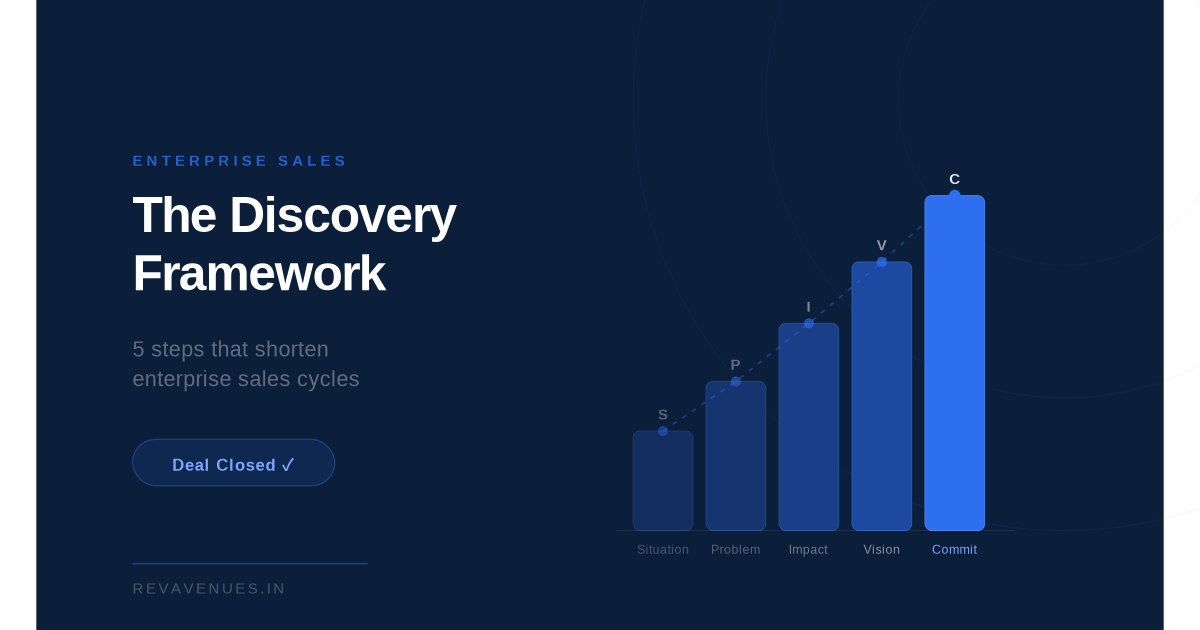
Most enterprise reps go into discovery to pitch. The best ones go in to understand. Here's the RevAvenues Discovery Framework — a 5-step process that consistently shortens cycles and raises close rates.
What is enterprise sales discovery?
Enterprise sales discovery is the structured process of understanding a buyer's situation, problems, impact, and vision before presenting any solution. Done well, discovery is the most valuable part of any enterprise sales cycle — it determines whether you're solving a real, urgent problem for someone with the authority and budget to act.
Most reps treat discovery as a checklist to get through before the demo. The best enterprise sellers treat it as the deal.
The RevAvenues Discovery Framework
Step 1: Situation — Map before you sell
Before diagnosing, understand where the buyer is today. Who owns the problem? What's their team structure? What's already been tried and why did it fail? Ask open questions and resist the urge to pitch.
Key questions: "Walk me through how your team currently handles [the problem area]." "What tools are you using today?" "What's worked and what hasn't?"
The goal here is not to find pain — it's to understand context. Buyers who feel heard in Step 1 open up in Step 2.
Step 2: Problem — Find the real pain
Surface-level problems hide deeper ones. "We need better reporting" usually means "we can't pull the numbers our board asks for in time." Keep asking "why does that matter?" until you're at the root cause.
Key question: "If this problem disappeared tomorrow, what would change for your team?"
This single question reliably separates real pain from casual interest. If they can't answer it clearly, the problem isn't urgent enough to buy.
Step 3: Impact — Quantify the cost of inaction
Buyers don't buy solutions. They buy relief from a quantified pain. Help them calculate what inaction is costing them in revenue lost, hours wasted, or risk taken on.
The most powerful discovery technique: let them do the math. "If your team spends 6 hours a week on this across 12 reps, that's 72 hours. What's your average fully-loaded rep cost per hour?" When buyers calculate their own pain, they convince themselves.
Step 4: Vision — Build the future state together
Don't tell buyers what their world could look like — ask. "What would an ideal solution handle for you?" When buyers describe the future state in their own words, they own it. Your solution becomes the path to their vision, not your pitch.
This is the step most reps skip. It's also the step that makes your proposal feel inevitable rather than intrusive.
Step 5: Commitment — Earn the next step
Never leave a discovery call without a specific, bilateral next step. Not "I'll follow up" — but "I'll send the ROI model by Thursday, and you'll loop in your CFO for our Friday call."
The commitment test: if the buyer won't agree to a specific next step, you haven't established enough urgency at Step 3. Go back and quantify the cost of inaction more concretely.
Results from the field
Teams that run this framework consistently report three outcomes: shorter discovery cycles (fewer wasted calls), higher demo-to-proposal conversion, and faster executive buy-in because the ROI story is built from the buyer's own numbers.
Frequently Asked Questions
What is sales discovery and why does it matter?
Sales discovery is the process of understanding a buyer's current situation, problems, and goals before presenting a solution. In enterprise sales, strong discovery is the single biggest driver of deal velocity — deals with thorough discovery close faster and at higher values.
How long should an enterprise discovery call be?
A proper enterprise discovery call typically runs 45–60 minutes. Shorter calls don't allow time to reach root causes; longer calls lose momentum. The goal is depth on 2–3 core pain areas, not breadth across every possible problem.
What questions should I ask in discovery?
The most effective discovery questions are open-ended and focused on impact: "What's the cost to your business when this breaks?" "Who else feels the pain of this problem?" "What would change if this was solved?" Avoid yes/no questions and feature-matching questions.
How is the RevAvenues Discovery Framework different from SPIN selling?
The RevAvenues Discovery Framework is built specifically for modern enterprise B2B sales with multiple stakeholders. While SPIN focuses on implication and need-payoff questions, the RevAvenues framework adds the Vision step — co-creating the future state — which is critical for consensus-based enterprise buying.
How do I handle a prospect who rushes past discovery to see the demo?
Acknowledge the request and earn more time: "Absolutely — I want to make sure the demo is worth your time and directly maps to your situation. Two quick questions first." Most buyers respect this if framed as being in their interest, not yours.
Ready to fix your enterprise pipeline?
RevAvenues helps B2B teams build repeatable enterprise revenue systems — from first touch to signed contract.
Talk to RevAvenues ↗